Monday, 13 May 2013

A Just Peace In Kashmir? Reflections On Dynamics Of Change


What are the various roles that diverse constituencies must play to facilitate political processes that undo militarization and subjugation in Indian administered Kashmir? How can systemic structures that institutionalize violence, cultural annihilation, economic impoverishment, and political disempowerment be countered through non-violent, ethical resistance? What alliances are necessary to allow hope for overcoming cycles of oppression and breaking with histories of domination? How can international, national, and local actors and institutions work together to disrupt socially unnecessary suffering and ameliorate the conditions of existence? What forces must cohere to enable a just peace to emerge in a democratic Kashmir in the foreseeable future?

Numerous obstacles present tremendous challenges to movements for social justice. The current world order is predicated on systems of inequality that hierarchically divide countries, peoples, cultures, classes, genders, sexualities, ethnicities, and faith traditions to the benefit of the few and the detriment of the many. Dominant powers prescribe the rules of the game to their advantage and utilize knowledge, technology, and markets to structure social relations in their interests. The new global order presents itself as the best of all possible worlds in which sovereign nation-states organized through representative democracy, rule of law, free markets with government regulation, Enlightenment rationality, and human rights are promised as the solution to the problems of poverty, war, ecological devastation, genocide, and terrorism.

This dominant narrative of progress through the spread of capitalism organized in nation-states and guided by knowledge has attained hegemony as it has captured the imagination of postcolonial nations like India. Postcolonial nations have largely reproduced the structures of colonial oppression and organized themselves to become players in the existing global order as militarized, hyper-masculinized, nuclear powers measuring their worth on the basis of GDP (Gross Domestic Product). Emerging middle-classes of massive proportion in postcolonial nations like India buttress this process of nation building that mirrors and enforces dynamics of globalization through the production of unparalleled poverty, massive and multiple dislocations, genocide of indigenous peoples, ecological disaster, and abundant psychological malaise. India is embraced by the international community, meaning largely the United States and Western Europe, precisely because it marches in step with the new world order. India amasses great cultural capital as “the world's largest democracy” in spite of the fact that it is home to 40% of the worlds most economically destitute, and seeks to constitute itself as a nation through policies that disregard the needs of the vast majority of its population.

India is inventing nothing new in its self-constitution as a powerful nation-state. National identity is being fabricated through the equation of India with Hindus, in blatant form in entities like the RSS and BJP, and in more subtle form in the Congress and progressive Indian citizens for whom nationalism linked to 'Hindu cultural reassertion' is an unreflective response to a colonial past. The equation of Hinduism (unity in diversity) and Christianity with tolerance for difference, and Islam with terrorism, backwardness, and fanaticism, functions as a global trope supportive of unleashing disproportionate violence on Muslims in Afghanistan, Iraq, and Palestine, as well as within the territory of India in Gujurat, Orissa, and in the 'disputed territory' of Kashmir. India forms itself as nation with unexamined Hindu majoritarianism at its base, just as unexamined Christian cultural dominance organizes the United States, rendering explorations of the links between religionization, nationalism and particular secularisms close to impossible. India is also typical in its self-formation as nation in fashioning internal and external enemies as crucial to defining itself, and super-exploiting its most proximate 'others' to fuel its prosperity. European nations had the Jew as internal enemy. The United States is founded on the backs of its twin others - enslaved Africans and massacred Native Americans.

India has as its main 'internal other' the Muslim, who can take no solace in also occupying the role as external enemy in India's dominant narrative. This double site is what the state uses to legitimate the brutalization of the Kashmiri people. Firstly, there is India's need for a majority Muslim state within its borders to legitimate itself as a progressive, pluralistic, secular nation. Without a Muslim majority state within India, India cannot as easily legitimate itself as a progressive member of the new global order. Secondly there is India's need to establish national identities that take precedence over regional, local, traditional identities. As a nation, India is in the process of seeking: (1) to establish territorial dominion over the current boundaries of the nation, (2) attain a monopoly on the means of violence, and (3) organize human and natural resources to enhance the productivity and power of the nation. Every nation that has achieved the normative status of modern democracy has utilized sustained and prolific violence to realize these three imperatives and in the process establish its identity. India is in a very vulnerable moment in this process as is evident from an examination of the myriad territories and forces fighting for autonomy in some form from the Indian state. Part of the strategy to foster national identity, simultaneous to providing very little to the vast majority of its population, and in fact fostering mal-development that impoverishes and displaces poor, rural 'citizens', is to fabricate an 'us' that must protect itself from 'them'. Without internal enemies India cannot unify itself as a nation.

This internal enemy is also resolutely claimed as integral to India. The state and its loyal subjects repeat the same refrain: 'Kashmir is an integral part of India.' 'Kashmir is integral to India.' Kashmir is the other that is integral to the self, a difference that is integral to the identity of India. How then does India treat this other, this integral difference? To debase, devalue, disrespect, destroy the people, culture, history, land, waters, aspirations, imaginations, passions, thoughts, of this other that is claimed as integral to self reveals much about India's current state of existence. What other measure is available to us to assess ourselves as ethical entities than how we treat the other, how we engage the differences to which we are ethically obliged to respond? What nation has satisfactorily answered to this call? If a day arrives when Kashmir is 'a nation unto itself', independent and sovereign, an equal to all other nations, will Kashmir point the nation-state in a new direction? Will the differences integral to Kashmir be respected, affirmed, heard and engaged? Will 'the other' be the call to 'the self' to practice hospitality? Will the Gujur, the village woman who buried loved ones and waits in silence for words of/from other loved ones, the atheist, the ardent believer, the Shia, the Sufi, the pundit, the Buddhist, the differently abled, the homosexual, the beggar, the prostitute, be welcomed as participants in constructing a nation that will be 'a light unto other nations'? Will the other be welcomed without the demand or structural incentive to assimilate, to mirror/mimic dominance to be recognized as human? These questions are too much, perhaps even unfair. Yet, is it not necessary to raise them?

Kashmir occupies a literal and imaginary border as inside and outside of India in ways that structure an impossible predicament. The state (and its elites and middle-classes) does not trust Kashmiris whose allegiance is always presumed to lie with Pakistan as an Islamic Republic, thus denying Kashmiris the rights of citizens of India, while asserting the inviolability of its sovereignty over Kashmir as a secular, democratic nation governed by equality under rule of law. The distrust legitimates military rule organized through special laws as necessary to provide law and order as a matter of internal security. Thus, on the basis of being part of a democratic state, the rights granted citizens of such a state are denied to Kashmiris. Inclusion in nation is coupled with dispossession from historical memory, rights, and life. India legitimates its mistreatment through a logic originating with European nation-states. This denial of civil and human rights, rule of law, and the freedoms of citizenship to Kashmiris is because the state must protect itself from forces within itself that threaten its character as a lawful, democratic nation. India must violate what is most inviolable, through a state of exception (the use of law to suspend law as definitive of sovereignty), to protect itself. The discourse requires the allegiance of the Kashmiri people to India, as proof that Kashmiris are not what the nation suspects - traitors and terrorists, as precondition to access to the rights of citizenship. These same rights of citizenship provided by the nation, while denied to Kashmiris, are used by India to justify its claims to being a legitimate state entitled to act as it does in Kashmir. As a legitimate state, India is predicated on civil rights and rule of law that it may legitimately suspend in the name of national security. Kashmiris must align with India given this legitimacy, while living as subjects without rights in so far as the state defines them as a threat to its sovereignty. India must violate what gives it legitimacy in order to protect itself from the internal enemy integral to it. India must destroy itself to protect itself. The state of exception produces a state of autoimmunity. India is also asserting itself as superior to other regional nation-states, and an emerging player in relation to Western Europe and the United States. Like other powerful democracies, India is entitled to do whatever is necessary to fight terrorism and strengthen itself as a powerful, sovereign, capitalist nation, aligned with the movement of progress (dominance).

Kashmiris are placed in a situation where allegiance to India as prerequisite to participation in a lawful democracy involves allegiance to a state that has no rational basis to demand or expect allegiance from the people of Kashmir. India needs to exaggerate the degree of cross-border infiltration and armed Islamist militancy to rationalize 500,000+ troops, blurred boundaries between police and army, and massive intervention in daily life through systematic surveillance, land seizures, checkpoints, torture, disappearances, gendered and sexualized violence, fake encounter deaths and countless daily humiliations calculated to break the spirit of the Kashmiri people. This reality is currently resisted through mass demonstrations, regular protests, strategic use of elections, strategic boycott of elections, navigating restrictions on 'free press', civil society mobilizations, legal cases, an International Tribunal, and regular acts of dignity, courage, and faith that characterize the present in Kashmir. India demonstrates the persona all too common in the 'league of nations' - to act with impunity and disregard for international law and local demands for justice. India uses this fiction of the Kashmiri as existing in the shadowy space of inside/outside the nation to legitimate an occupation that ignores the historical particularity of Kashmir and the promises made to the people of Kashmir to determine its own future. The plight of Kashmiri pundits also becomes an opportunity for the state to legitimate regularized violence and systematic oppression of Kashmiris. Were all Kashmiris, whether currently residing in the state of Jammu/Kashmir or elsewhere, to be given voice to express their will, free from coercion, retribution, and manipulation, the outcome would not be in doubt.

Kashmir is the longest standing disputed area in the United Nations, the most militarized spot on earth, and a drain on the hopes for prosperity, peace and freedom for people throughout the subcontinent, and the world. There is no moving toward peaceful coexistence between India and Pakistan, no stabilization of the region, no possibility for global nuclear disarmament, no hope for forms of development that prioritize sustainability and cultural survival over militarization, urbanization, and middle-class consumerism, no space for the impossible healing through mourning/memorializing the trauma of Partition, without granting self-determination to the people of Kashmir.

The realization of that which is demanded by rationality in service of justice and emancipation is always against the odds. In relation to Kashmir, a more peaceful future requires at least four interrelated movements: (1) Massive, non-violent, ethical dissent within Kashmiri civil society must continue and expand, attentive to alliances that build stronger relations between men and women, youth and adults, various faith communities, urban and rural, rich and poor, facilitative of inclusive forms of polity that enable a diverse, pluralistic movement for freedom. (2) Leadership must form a unified coalition that activates and learns from the multiple constituencies that make up Kashmiri society. Divergent desires and imaginations regarding the future of Kashmir should be encouraged and discussed, outside the search for homogeneity or conformity. A Kashmir free of subjugation should enable multiple forms of life through participatory democracy, just governance, and economic practice promoting health, education, and individual and collective prosperity. Natural resources, like water, should be both safeguarded, and utilized for sustainable development. Cultural heritage should be understood as an inheritance of all Kashmiris to fashion a unique society nurturing hospitality, innovation, and multicultural polity. (3) Education and mobilization to shift public opinion in India must be undertaken throughout civil society to expand pressure on the Indian state. Citizen delegations from the various states and communities of India must visit Kashmir to learn first hand about the atrocities, resistances, hopes, and concerns prevalent in Kashmir. Such delegations must bring their new understandings to their neighborhoods, schools, workplaces, and places of worship to facilitate discussion and reflection that expand the voices of those who demand that illegal and immoral action in Kashmir done in their name immediately cease. Institutions in India must sponsor delegations from Kashmir, composed of diverse peoples who constitute Kashmiri society, to share the realities they have suffered and the need for alliance toward justice. Hindu faith communities must forge relationships with social justice movements in civil society in Kashmir to oppose Hindu majoritarian dominance and insist that the Indian state demilitarize the state of Jammu & Kashmir, become accountable to international agreements, rule of law, and human rights as the first step on the road to affirming the right of Kashmir to self-determination. Universities and the press must play a strong role in addressing the history and present of Kashmir to empower students and the citizenry of India to participate as informed members of a democratic republic, whose resources and conscience are systematically misused and violated by their government. (4) International solidarities from citizens, governmental and non-governmental organizations, students, workers, professionals, public intellectuals, faith communities, and all interested parties must be organized to educate, inform, advocate, and mobilize for the liberation of Kashmir. International institutions must be both utilized and strengthened as legitimate sites able to hold nation-states legally accountable for their actions. Research, education, and publication on the reality of present-day Kashmir and its modern history must be supported by and within universities, think tanks, and civil society forums. Campuses must become sites where students mobilize themselves to exert public pressure to ethically resolve the situation in Kashmir. Resistance in all four 'sites' must struggle to establish alliances, clarify goals, mobilize resources, deconstruct desires, and carve out space where different forms of polity and community, promoting ethical dissent, may live.

To commit to these practices secures no guarantees. The process must draw from the resolve of Kashmiris to struggle for justice and strengthen this resolve through principled alliance that breaks the isolation and despair that accompanies any people subjected to brutal mistreatment. The multiple legacies that inspire and haunt us must become the very sustenance that, through sharing, nurtures our struggle. Allow me to conclude by drawing from a source common to the three Abrahamic traditions, and of universal relevance in the present, Deuteronomy 16:20, Justice, Justice, You Shall Pursue. 

Richard Shapiro is Chair and Associate Professor, Department of Social and Cultural Anthropology, California Institute of Integral Studies in San Francisco.

Previously Published on Counter Currents on 7th Aug 2009
Friday, 15 February 2013

India's message to Kashmir: the noose can extend beyond the gallows

"First, Kashmiri Afzal Guru was hanged and now the region is under curfew in India's heartless display of retributive justice" 

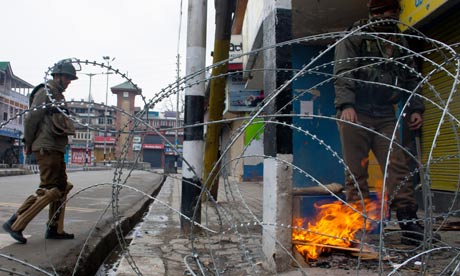
Indian policemen enforce a curfew in Srinagar, Kashmir, after Afzal Guru was executed in India for his involvement in the attack on India's parliament in 2001, when nine people were killed. Photograph: Yawar Nazir/Getty Images


A curfew is like a collective strangulation. You proscribe movement, talk, communication and assembly. You cut off the very sustenance of life: food, milk, medicine. You choke a people, because you fear, no, dread, what the curfewed other might say to the world. Indian-controlled Kashmir has been under curfew for the last five days; everything is shut down, locked up, besieged. Newspapers have been seized, editors verbally instructed by police officials not to print, TV channels, except of course the government-run ones, have been blocked. People are not allowed to travel except if you have a bullet in your body and are still breathing inside an ambulance. This latest imposition – Kashmir's modern history is bookmarked by chapter after chapter of sieges and martial-law like curfews – came soon after Mohammad Afzal Guru was hanged by India for his involvement in the attack on India's parliament in 2001 in which nine people were killed.
In a case widely criticised for its dodgy investigation, the absence of a fair trial and most crucially, the lack of evidence beyond reasonable doubt, the supreme court of India, upholding sentences of lower courts, sentenced Afzal Guru to a double death sentence in 2005. There was only circumstantial evidence against him, the court admitted, but the "collective conscience of society" could only be soothed with this execution. As soon as what many call a miscarriage of justice was performed in Delhi's Tihar Jail, the Indian government effectively shut off the Valley from the world. It was almost automatic, a reflex, and why wouldn't it be, for the powerful and increasingly militaristic Indian state is well rehearsed in dealing with the oppressed and weak of Kashmir.
So the run of play in this heartless display of retributive justice was this: you hang a Kashmiri in Delhi and then, to complete the picture, to make the performance full, immediately put Kashmir under a military siege. A country that needs to impose a curfew every time it fears what it calls "unrest" in a region that it claims as an integral part should by now have learned that it is not an integral part. It never was.
It was not just the hanging but also the manner of it – executed while the world slept, in secret and in great haste, as thieves do when they embark on their dark deeds – that makes this execution a symbol of the deep moral rot at the heart of the Indian state. Indian authorities chose not to inform Afzal Guru's family prior to the hanging and quietly buried him in prison. His brother has said they learned of his execution on TV. A letter sent by the government of India to Afzal Guru's wife reached her two days after the execution. Even the public prosecutor responsible for Afzal Guru's trial has admitted that it was a violation of his rights as well as of India's prison manuals that state a person on death row must be allowed family visits.
What kind of state makes sure that the wife and young son of a man it is about to execute, do not see him, touch him or hear him talk, one last time? Kashmiris, in mourning and in fury, erected a tombstone over an empty grave in the main martyrs' graveyard in the Kashmiri capital, Srinagar. The text of the epitaph was the same as that of another epitaph, erected in memory of Maqbool Bhat, the founder of Kashmir's main pro-independence militant group turned political formation the Jammu and Kashmir Liberation Front, who was hanged in the same jail 29 years ago. The epitaph reads, "The martyr of the nation, Mohammad Afzal Guru, Date of Martyrdom: 9th February 2013 Saturday, whose mortal remains are lying in the custody of the Government of India. The nation is awaiting its return."
On the morning of 13 February, Kashmiri news websites reported that the police had removed and destroyed the tombstone and then, after the news spread via Twitter and Facebook, a replacement tombstone mysteriously reappeared. The Kashmiri phrases, Qabr Chhoor and Kafan Chhoor, titles for those who rob graves or shrouds are deployed to describe the basest of thieves. The swiftness of the execution, and the macabre theatre that followed, which included an offer by the Indian government that Afzal's family will be allowed to pray once by his grave in prison that the family promptly turned down, is disturbingly reminiscent of Franco's Spain.
I learned of the execution in London and struggled to make sense of it. I still do. It was, for reasons moral and legal – judicial review is available to even people denied a presidential pardon – somehow unbelievable, although by no means unexpected. Does the world's so-called largest democracy really want to be seen as a nation revelling in a retrograde, made-for-TV bloodlust?
I began to think of Ghalib, Afzal Guru's 14-year-old son, who, accompanied by his mother a few years ago, went to the head of the Indian state with a mercy petition, begging the president to pardon his father's life. Clearly, the president wasn't listening. He had to, as the judge had decreed in the supreme court of India's verdict, satisfy the "collective conscience of the society," which will "only be satisfied if capital punishment is awarded to the offender".
It is of course impossible to understand the complex moral arithmetic necessary to arrive at the perfect potion needed to assuage the collective conscience of a billion people. I began to think of writing about it, answering an urge to say what I, and many others, felt. I struggled, despairing about the powerlessness, and perhaps pointlessness, of an op-ed or essay. I also began to feel lonely, for in spite of the proliferation of conversations on social media, a solidarity of the oppressed and the besieged is hard to find amid the buzz of the internet or a postmodern metropolis.
What was the Indian state trying to say, one must ask? Surely, it can't simply be explained, as some analysts have done, as merely a hideous expression of the compulsions of electoral realpolitik in which political parties in India become eager to sink to new moral lows to outdo their rivals. It's a message to the Kashmiri people, an occupying power yelling at the powerless natives that you must bow and genuflect, that the hangman's noose can extend beyond the gallows, casting its dark shadow over children's milk and medicines for old couples.
Two moments seem to have entered history. Kashmiris creating a hollow grave as a mausoleum to memory and resistance and India making a craven declaration: that a Kashmiri corpse can be seditious. It must remain in prison.

Previously Published On Guardian UK 

Monday, 11 February 2013

Protest videos against the hanging of Shaheed Afzal Guru

Delhi 


Hyderabad


Mulakat Afzal


A RUSTED TABLE, and behind it, a well-built man in uniform holding a spoon in his hand. Visitors, all of them looked habituated to the procedure, queued up to open their plastic bags containing food, allowing it to be smelled, sometimes even tasted. The security man’s spoon swam through curries thick with floating grease—malai kofta, shahi paneer, aalu baingan, and mixed vegetables. As the visitors opened tiny bags of curries, the spoon separated each piece of vegetable from the other mechanically. After ‘frisking’ the food of a middle-aged woman, the spoon was dipped in water in a steel bowl nearby. It then moved to the plastic bags of the next person in the queue, a boy in his early teens. By this time, the water in the steel bowl had acquired all kinds of colours, the floating oil setting off rainbow hues in the light of the winter afternoon.
Around 4.30 pm, it was my turn. The man left the spoon on the table and frisked my body, top to bottom, thrice, thoroughly. When the metal detector made a noise, I had to remove my belt, steel watch, and keys. The man on duty bearing the badge of the Tamil Nadu Special Police (TSP) looked satisfied. I was allowed to enter now. This was the fourth security drill I had to go through to get into the High Risk Ward of Prison No. 3 in Tihar Central Prison. I was on my way to meet Mohammad Afzal, one of the most talked about men in contemporary times.
I entered a room with many tiny cubicles. Visitors and inmates were separated by a thick glass and iron grills. They were connected through microphones and speakers fixed on the wall. But the audibility was poor, and people on either sides of the glass strained their ears, touching them to the wall to listen to each other. Mohammad Afzal was already at the other side of the cubicle. His face gave me an impression of unfathomable dignity and calmness. He was a slight, short man in his mid-thirties, wearing a white kurta-pyjama, with a Reynolds pen in his pocket. A very clear voice welcomed me with the utmost politeness.
“How are you, sir?”
I said I was fine. Was I to return the same question to a man on deathrow? I was apprehensive for a second, but I did. “Very fine. Thank you sir,” he answered with warmth. The conversation went on for close to an hour, and continued a fortnight later with a second mulakat. Both of us were in a hurry to answer and ask whatever we could in the time we had. I continuously scribbled in my tiny pocket book. He seemed to be a person who wanted to say a lot of things to the world. But he often reiterated his helplessness in reaching people from his current state of ‘condemned for life’. Excerpts of the interview.
There are so many contradicting images of Afzal. Which Afzal am I meeting?
Is it? But as far as I’m concerned there is only one Afzal. That is me. Who is that Afzal?
[A moment’s silence.]
Afzal as a young, enthusiastic, intelligent, idealistic young man. Afzal, a Kashmiri influenced, like many thousands in the Kashmir Valley, in the political climate of early 1990s. Who was a JKLF member and crossed over to the other side of Kashmir, but in a matter of weeks got disillusioned and came back and tried to live a normal life, but was never allowed to do so by the security agencies, who inordinate times picked me up, tortured the pulp out of me, electrocuted, frozen in cold water, dipped in petrol, smoked in chillies you name it. And falsely implicated in a case, with no lawyer, no fair trial, finally condemned to death. The lies the police told was propagated by you in media. And that perhaps created what the Supreme Court referred to as “collective conscience of the nation”. And to satisfy that “collective conscience”, I’m condemned to death. That is the Mohammad Afzal you are meeting.
[After a moment's silence, he continued.]
But I wonder whether the outside world knows anything about this Afzal. I ask you, did I get a chance to tell my story? Do you think justice is done? Would you like to hang a person without giving him a lawyer? Without a fair trial? Without listening to what he had to go through in life? Democracy doesn’t mean all this, does it?
Can we begin with your life? Your life before the case…
It was a turbulent political period in Kashmir when I was growing up. Maqbool Bhatt was hanged. The situation was volatile. The people of Kashmir decided to fight an electoral battle once again to resolve the Kashmir issue through peaceful means. Muslim United Front [MUF] was formed to represent the sentiments of Kashmiri Muslims for the final settlement of the Kashmir issue. Administration at Delhi was alarmed by the kind of support that MUF was gaining, and in the consequence, we saw rigging in the election on an unprecedented scale.
And the leaders who took part in the election and won with huge majority were arrested, humiliated and put behind bars. It is only after this that the same leaders the gave call for armed resistance. In response, thousands of youth took to armed revolt. I dropped out from my MBBS studies in Jhelum Valley Medical College, Srinagar. I was also one of those who crossed to the other side of Kashmir as a JKLF member, but was disillusioned after seeing Pakistani politicians acting the same as the Indian politicians in dealing with Kashmiris. I returned after few weeks. I surrendered to the security force, and you know, I was even given a BSF certificate as a surrendered militant. I began to start the life new. I could not become a doctor but I became a dealer of medicines and surgical instruments on commission basis. [Laughs.]

With the meagre income, I even bought a scooter and also got married. But never a day passed by without the scare of Rashtriya Rifles and STF men harassing me. If there was a militant attack somewhere in Kashmir, they would round up civilians, torture them to pulp. The situation was even worse for a surrendered militant like me. They detained us for several weeks, and threatened to implicate in false cases and we were let free only if we paid huge bribes. Many times I had to go through this. Major Ram Mohan Roy of 22 Rashtriya Rifles gave electric shock to my private parts. Many times I was made to clean their toilets and sweep their camps. Once, I had to bribe the security men with all that I had to escape from the Humhama STF torture camp. DSP Vinay Gupta and DSP Davinder Singh supervised the torture. One of their torture experts, Inspector Shanti Singh, electrocuted me for three hours until I agreed to pay Rs. 1 lakh as bribe. My wife sold her jewelry and for the remaining amount, they sold my scooter.
I left the camp broken, both financially and mentally. For six months I could not go outside home because my body was in such a bad shape. I could not even share the bed with my wife as my penile organ had been electrocuted. I had to take medical treatment to regain potency…
[Afzal narrated the torture details with a disturbing calmness on his face. He seemed to have lot of details to tell me about the torture he faced. But, unable to hear the horror stories of security forces that operate with my tax money, I cut him short and asked:]
If you could come to the case, what were the incidents that led to the Parliament attack case?
After all the lessons I learned in STF camps, which is either you and your family members get harassed constantly for resisting, or cooperate with the STF blindly, I had hardly any options left, when DSP Davinder Singh asked me to do a small job for him. That is what he told, “a small job”. He told me that I had to take one man to Delhi. I was supposed to find a rented house for him in Delhi. I was seeing the man first time, but since he did not speak Kashmiri, I suspected he was an outsider. He told his name was Mohammad [Mohammad is identified by the police as the man who led the five gunmen who attacked Parliament. All of them were killed by the security men in the attack].
When we were in Delhi, Mohammad and me used to get phone calls from Davinder Singh. I had also noticed that Mohammad used to visit many people in Delhi. After he purchased a car, he told me now I could go back and gave me Rs. 35,000 saying it was a gift. And I left to Kashmir for Eid.
When I was about to leave to Sopore from Srinagar bus stand, I was arrested and taken to Parimpora police station. They tortured me and took me to STF headquarters, and from there brought me to Delhi.
In the torture chamber of Delhi Police Special Cell, I told them everything I knew about Mohammad. But they insisted that I should say that my cousin Showkat, his wife Navjot, SAR Geelani and I were the people behind the Parliament attack. They wanted me to say this convincingly in front of media. I resisted. But I had no option than to yield when they told me my family was in their custody and threatened to kill them. I was made to sign many blank pages and was forced to talk to the media and claim responsibility for the attack by repeating what the police told me to say. When a journalist asked me about the role of SAR Geelani, I told him Geelani was innocent. ACP Rajbeer Singh shouted at me in the full media glare for talking beyond what they tutored. They were really upset when I deviated from their story, and Rajbeer Singh requested the journalists not to broadcast that part where I spoke of Geelani’s innocence.
Rajbeer Singh allowed me to talk to my wife the next day. After the call, he told me if I wanted to see them alive I had to cooperate. Accepting the charges was the only option in front of me if I wanted to see my family alive, and the Special Cell officers promised they would make my case weak so I would be released after sometime. Then they took me to various places and showed me the markets where Mohammad had purchased different things. Thus they made the evidence for the case.
Police made me a scapegoat in order to mask their failure to find out the mastermind of Parliament attack. They have fooled the people. People still don’t know whose idea was to attack Parliament. I was entrapped into the case by Special Task Force (STF) of Kashmir and implicated by Delhi Police Special Cell.
The media constantly played the tape. The police officers received awards. And I was condemned to death.
Why didn’t you find legal defence?
I had no one to turn to. I did not even see my family until six months into the trial. And when I saw them, it was only for a short time in the Patiala House Court. There was no one to arrange a lawyer for me. As legal aid is a fundamental right in this country, I named four lawyers whom I wished to have defended me. But the judge, SN Dhingra, said all four refused to do the case. The lawyer whom the court chose for me began by admitting some of the most crucial documents without even asking me what the truth of the matter was. She was not doing the job properly, and finally she moved to defend another fellow accused. Then the Court appointed an amicus curie, not to defend me, but to assist court in the matter. He never met me. And he was very hostile and communal. That is my case, completely unrepresented at the crucial trial stage.
The fact of the matter is that I did not have a lawyer and in a case like this, what does not having a lawyer mean, everyone can understand. If you wanted to put me to death, what was the need for such a long legal process which to me was totally meaningless?
Do you want to make any appeal to the world?
I have no specific appeals to make. I have said whatever I wanted to say in my petition to the President of India. My simple appeal is that do not allow blind nationalism and mistaken perceptions to lead you to deny even the most fundamental rights of your fellow citizens. Let me repeat what SAR Geelani said after he was awarded death sentence at the trial court. He said, peace comes with justice. If there is no justice, there is no peace. I think that is what I want to say now. If you want to hang me, go ahead with it, but remember it would be a black spot on the judicial and political system of India.
What is the condition in jail?
I’m lodged in solitary confinement in the high risk cell. I’m taken out from my cell only for a short period during noon. No radio, no television. Even the newspaper I subscribe reaches me torn. If there is a news item about me, they tear that portion apart and give me the rest.
Apart from the uncertainty about your future, what else concerns you the most?
Yes, a lot of things concern me. There are hundreds of Kashmiris languishing in different jails, without lawyers, without trial, without any rights. The situation of civilians in the streets of Kashmir is not any different. The valley itself is an open prison. These days the news of fake encounters is coming out. But that is only the tip of a big iceberg. Kashmir has everything that you don’t want to see in a civilized nation. They breathe torture. Inhale injustice.
[He paused for a moment.]
Also, there are so many thoughts that come into my mind; farmers who get displaced, merchants whose shops are sealed in Delhi, and so on. So many faces of injustice you can see and identify, can’t you? Have you thought how many thousands of people get affected by all this, their livelihood, family…? All these things, too, worry me.
[Another, longer, pause.]
Also, global developments. I took to the news of the execution of Saddam Hussain with utmost sadness. Injustice, so openly and shamelessly done. Iraq, the land of Mesopotamia, world’s richest civilisation, that taught us mathematics, use a 60-minute clock, 24-hour day, 360-degree circle, is thrashed to dust by the Americans. Americans are destroying all other civilisations and value systems. Now the so called War against Terrorism is only good in spreading hatred and causing destruction. I can go on saying what worries me.
Which books are you reading now?
I finished reading Arundhati Roy. Now I’m reading Sartre’s work on existentialism. You see, it is a poor library in the jail. So I will have to request the visiting Society for the Protection of Detainees and Prisoners Rights (SPDPR) members for books.
There is a campaign in defence for you…
I am really moved and obliged by the thousands of people who came forward saying injustice is done to me. The lawyers, students, writers, intellectuals, and all those people are doing something great by speaking against injustice. The situation was such at the beginning, in 2001, and initial days of the case that it was impossible for justice-loving people to come forward. When the High Court acquitted SAR Geelani, people started questioning the police theory. And when more and more people became aware of the case details and facts and started seeing things beyond the lies, they began speaking up. It is natural that justice-loving people speak up and say injustice is done to Afzal. Because that is the truth.
Members of your family have conflicting opinions on your case?
My wife has been consistently saying that I was wrongly framed. She has seen how the STF tortured me and did not allow me to live a normal life. She also knew how they implicated me in the case. She wants me to see our son, Ghalib, growing up. I have also an elder brother who apparently is speaking against me under duress from the STF. It is unfortunate what he does, that’s what I can say.
See, it is a reality in Kashmir now, what you call the counter insurgency operations take any dirty shape—that they field brother against brother,
neighbour against neighbour. You are breaking a society with your dirty tricks. As far as the campaign is concerned I had requested and authorised Society for the Protection of Detainees and Prisoners Society (SPDPR) run by Geelani and group of activists to do the campaign.

What comes to your mind when you think of your wife, Tabassum, and son, Ghalib?
This year is the tenth anniversary of our wedding. Over half that period I spent in jail. And prior to that, many a times I was detained and tortured by Indian security forces in Kashmir. Tabassum witnessed both my physical and mental wounds. Many times I returned from the torture camp, unable to stand, all kinds of torture, including electric shock to my penis. She gave me hope to live. We did not have a day of peaceful living. It is the story of many Kashmiri couples. Constant fear is the dominant feeling in all Kashmiri households.
We were so happy when a child was born. We named our son after the legendary poet Mirza Ghalib. We had a dream to see our son, Ghalib, grow up. I could spend very little time with him. After his second birthday, I was implicated in the case.
What do you want him to grow up as?
Professionally, if you are asking, a doctor. Because that is my incomplete dream.
But most importantly, I want him to grow without fear. I want him to speak against injustice. That I am sure he will be. Who else know the story of injustice better than my wife and son?
[While Afzal continued talking about his wife and son, I could not help but recollect what Tabassum told me when I met her outside the Supreme Court in 2005, during the case’s appeal stage. While Afzal’s family members remained in Kashmir, Tabassum dared to come to Delhi with her son, Ghalib, to organise defence for Afzal. Outside the Supreme Court New Lawyers chamber, at the tiny tea stall on the roadside, she chatted in detail about Afzal. While sipping and complaining about the excess sugar in the tea, she talked about how Afzal enjoyed cooking. One picture she painted struck me. It was one of the few precious private moments in their lives: when Afzal would not allow her to enter the  kitchen, but would make her sit on the chair nearby and he would cook, holding a book in one hand, a ladle in the other and read out stories for her.]
If I may ask you about the Kashmir issue, how do you think it can be solved?
First, let the government be sincere to the people of Kashmir. And let them initiate talk with the real representatives of Kashmir. Trust me, the real representatives of Kashmir can solve the problem. But if the government considers the peace process as a tactic of counter insurgency, then the issue is not going to be solved. It is time some sincerity is shown.
Who are the real people?
Find out from the sentiments of the people of Kashmir. I am not going to name x, y or z.
And I have an appeal to the Indian media; stop acting as a propaganda tool. Let them report the truth. With their smartly worded and politically loaded news reports, they distort facts, make incomplete reports, build hardliners, terrorists et al. They easily fall for the games of the intelligence agencies. By doing insincere journalism, you are adding to the problem. Disinformation on Kashmir should stop first. Allow Indians to know the complete history of the conflict, let them know the ground realities. True democrats cannot turn down the facts. If the Indian government is not taking into account the wishes of the Kashmiri people, then they can’t solve the problem. It will continue to be a conflict zone.
Also, you tell me how are you going to develop real trust among Kashmiris when you send out the message that India has a justice system that hangs people without giving them a lawyer, without a fair trial? Tell me, when hundreds of Kashmiris are lodged in jails, most of them with no lawyer, no hope for justice, are you not further escalating the distrust of the Indian government among Kashmiris? Do you think if you don’t address the core issues and do a cosmetic effort, you can solve the Kashmir conflict? No, you can’t. Let the democratic institutions of both India and Pakistan start showing some sincerity, their politicians, Parliament, justice system, media, intellectuals ...
Nine security men were killed in the Parliament attack. What is it that you have to tell their relatives?
In fact, I share the pain of the family members who lost their dear ones in the attack. But I feel sad that they are misled to believe that hanging an innocent person like me would satisfy them. They are used as pawns in a completely distorted cause of nationalism. I appeal them to come out of it and see through things.
What do you see is your achievement in life?
My biggest achievement perhaps is that through my case and the campaign on the injustice done to me, the horror of STF has been brought to light. I am happy that now people are discussing security forces’ atrocities on civilians, encounter killings, disappearances, torture camps, etc. These are the realities that a Kashmiri grows up with. People outside Kashmir have no clue what Indian security forces are up to in Kashmir.
Even if they kill me for no crime of mine, it would be because they cannot stand the truth. They cannot face the questions arise out of hanging a Kashmiri with no lawyer.
[An ear-splitting electric bell rang. I could hear hurried conversations from the neighbouring cubicles. This was my last question to Afzal.]
What do you want to be known as?
[He thought for a minute, and answered.]
As Afzal, as Mohmammad Afzal. I am Afzal for Kashmiris, and I am Afzal for Indians as well, but the two groups have an entirely conflicting perception of my being. I would naturally trust the judgment of Kashmiri people, not only because I am one among them, but also because they are well aware of the reality I have been through, and they cannot be misled into believing any distorted version of either a history or an incident.

I WAS CONFUSED by this last statement of Mohammad Afzal, but on further reflection, I began to understand what he meant. This was a time before clear accounts of the strife had begun to emerge from Kashmiri voices; the source of knowledge on Kashmir for most Indians were textbooks and media reports. To hear about the history of Kashmir and incidents in the state from a Kashmiri was usually a shock to most Indians—as it was to me when I listened to Afzal.
Two more bells. It was time to end the mulakat. But people were still busy conversing. The microphone was put off. The sounds from the speaker stopped. But if you strained your ear, and watched his lip movements, you could still hear him. The guards made rough round-ups, asking everyone to leave. As they found visitors reluctant to leave, they put the lights off. The mulakat room turned dark.
In the long walk out from Jail No 3 of the Tihar jail compound to the main road, I found myself in the company of people in clusters of twos and threes, moving out silently—mother, wife and daughter; or brother, sister and wife; or friend and brother; or someone else. Every cluster had two things in common. They carried an empty cotton bag back with them. Those bags had stains of malai kofta, shahi paneer and mixed vegetables, many caused  by the spills from the rash frisking of the TSP man’s spoon. The second thing in common, I observed, was that they all wore inexpensive winter clothes, torn shoes, and outside Gate No 3 they waited for Bus No 588, the Tilak Nagar-Jawaharlal Nehru Stadium bus, that perhaps took them to Dhaula Kuan main junction—they were the poor citizens of this country.
I remembered former president Abdul Kalam’s musing on how poor people were the awardees of capital punishments. My interviewee was also one. When I had asked him how many ‘tokens’ (the form of currency allowed in the jail) he had, he said “enough to survive”.

Previously Published on Caravan Magazine

Sunday, 10 February 2013

The hanging of Afzal Guru is a stain on India's democracy

"Despite gaping holes in the case against Afzal Guru, all India's institutions played a part in putting a Kashmiri 'terrorist' to death"


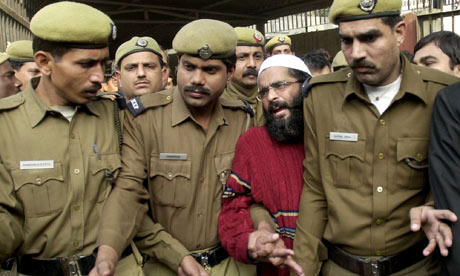
Indian police bring Afzal Guru to court in Delhi in 2002.
Photograph: Aman Sharma/AP
Spring announced itself in Delhi on Saturday. The sun was out, and the law took its course. Just before breakfast, the government of India secretly hanged Afzal Guru, prime accused in the attack on parliament in December 2001, and interred his body in Delhi's Tihar jail where he had been in solitary confinement for 12 years. Guru's wife and son were not informed. "The authorities intimated the family through speed post and registered post," the home secretary told the press, "the director general of the Jammu and Kashmir [J&K] police has been told to check whether they got it or not". No big deal, they're only the family of yet another Kashmiri terrorist.
In a moment of rare unity the Indian nation, or at least its major political parties – Congress, the Bharatiya Janata party and the Communist party of India (Marxist) – came together as one (barring a few squabbles about "delay" and "timing") to celebrate the triumph of the rule of law. Live broadcasts from TV studios, with their usual cocktail of papal passion and a delicate grip on facts, crowed about the "victory of democracy". Rightwing Hindu nationalists distributed sweets to celebrate the hanging, and beat up Kashmiris (paying special attention to the girls) who had gathered in Delhi to protest. Even though Guru was dead and gone, the commentators in the studios and the thugs on the streets seemed, like cowards who hunt in packs, to need each other to keep their courage up. Perhaps because, deep inside, themselves they knew they had colluded in doing something terribly wrong.
What are the facts? On 13 December 2001 five armed men drove through the gates of the Indian parliament in a car fitted out with a bomb. When challenged they jumped out of the car and opened fire, killing eight security personnel and a gardener. In the firefight that followed, all five attackers were killed. In one of the many versions of the confessions he was forced to make in police custody, Guru identified the men as Mohammed, Rana, Raja, Hamza and Haider. That's all we know about them. They don't even have second names. LK Advani, then home minister in the BJP government, said they "looked like Pakistanis". (He should know what Pakistanis look like right? Being a Sindhi himself.) Based only on Guru's custodial confession (which the supreme court subsequently set aside, citing "lapses" and "violations of procedural safeguards") the government recalled its ambassador from Pakistan and mobilised half a million soldiers on the Pakistan border. There was talk of nuclear war. Foreign embassies issued travel advisories and evacuated their staff from Delhi. The standoff lasted months and cost India thousands of crores – millions of pounds.
Within 24 hours, the Delhi Police Special Cell (notorious for its fake "encounter" killings, where suspected terrorists are targeted in extrajudicial attacks) claimed it had cracked the case. On 15 December it arrested the "mastermind", Professor SAR Geelani, in Delhi, and Showkat Guru and his cousin Afzal Guru in Srinagar, Kashmir. Subsequently, they arrested Afsan Guru, Showkat's wife. The Indian media enthusiastically disseminated the police version. These were some of the headlines: "Delhi university lecturer was terror plan hub", "Varsity don guided fidayeen", "Don lectured on terror in free time." Zee TV, a national network, broadcast a "docudrama" called December 13, a recreation that claimed to be the "truth based on the police charge sheet". (If the police version is the truth, why have courts?) The then prime minister, Atal Bihari Vajpayee, and Advani publicly applauded the film. The supreme court refused to postpone the screening, saying that the media would not influence judges. It was broadcast only a few days before the fast-track court sentenced Geelani and Afzal and Showkat Guru to death. Subsequently the high court acquitted Geelani and Afsan Guru. The supreme court upheld the acquittal. But in its 5 August 2005 judgment it gave Afzal Guru three life sentences and a double death sentence.
The BJP called for an immediate execution. One of its election slogans was "Desh abhi sharminda hai, Afzal abhibhi zinda hai", which means (in stirring rhyme), "Our nation is ashamed because Afzal is still alive". In order to blunt the murmurs that had begun to surface, a fresh media campaign began. Chandan Mitra, now a BJP MP, then editor of the Pioneer newspaper, wrote: "Afzal Guru was one of the terrorists who stormed parliament house on 13 December 2001. He was the first to open fire on security personnel, apparently killing three of the six who died." Even the police charge sheet did not accuse Afzal of that. The supreme court judgment acknowledged the evidence was circumstantial: "As is the case with most conspiracies, there is and could be no evidence amounting to criminal conspiracy." But then, shockingly, it went on to say: "The incident, which resulted in heavy casualties, had shaken the entire nation, and the collective conscience of society will only be satisfied if capital punishment is awarded to the offender."
Who crafted our collective conscience on the parliament attack case? Could it have been the facts we gleaned in the papers? The films we saw on TV? Before celebrating the rule of law, let's take a look at what happened.
The people who are celebrating the victory of the rule of law argue that the very fact that the Indian courts acquitted Geelani and convicted Afzal proves that the trial was free and fair. Was it?
The trial in the fast-track court began in May 2002. The world was still convulsed by post 9/11 frenzy. The US government was gloating prematurely over its "victory" in Afghanistan. In the state of Gujarat, the massacre of Muslims by Hindu goon squads, helped along by the police and the state government machinery that had begun in late February, was still going on sporadically. The air was charged with communal hatred. And in the parliament attack case the law was taking its own course. At the most crucial stage of a criminal case, when evidence is presented, when witnesses are cross-examined, when the foundations of the argument are laid – in the high court and supreme court you can only argue points of law, you cannot introduce new evidence – Afzal Guru, locked in a high-security solitary cell, had no lawyer. The court-appointed junior lawyer did not visit his client even once in jail, he did not summon any witnesses in Guru's defence, and he did not cross-examine the prosecution witnesses. The judge expressed his inability to do anything about the situation.
Even so, from the word go the case fell apart. A few examples out of many: The two most incriminating pieces of evidence against Guru were a cellphone and a laptop confiscated at the time of arrest. They were not sealed, as evidence is required to be. During the trial it emerged that the hard disk of the laptop had been accessed after the arrest. It only contained the fake home ministry passes and the fake identity cards that the "terrorists" used to access parliament – and a Zee TV video clip of parliament house. So according to the police, Guru had deleted all the information except the most incriminating bits. The police witness said he sold the crucial sim card that connected all the accused in the case to one another to Guru on 4 December 2001. But the prosecution's own call records showed the sim was actually operational from 6 November 2001.
How did the police get to Afzal? They said that Geelani led them to him. But the court records show that the message to arrest Afzal went out before they picked up Geelani. The high court called this a "material contradiction" but left it at that.
The arrest memos were signed by Bismillah, Geelani's brother, in Delhi. The seizure memos were signed by two men from the J&K police, one of them an old tormentor from Afzal's past as a surrendered "militant".
It goes on and on, this pile up of lies and fabricated evidence. The courts note them, but for their pains the police get no more than a gentle rap on their knuckles. Nothing more.
Anyone who was really interested in solving the mystery of the parliament attack would have followed the dense trail of evidence on offer. No one did, thereby ensuring the real authors of the conspiracy will remain unidentified and uninvestigated.
The real story and the tragedy of what happened to Guru is too immense to be contained in a courtroom. The real story would lead us to the Kashmir valley, that potential nuclear flashpoint, and the most densely militarised zone in the world, where half a million Indian soldiers (one to every four civilians) and a maze of army camps and torture chambers that would put Abu Ghraib in the shade are bringing secularism and democracy to the Kashmiri people. Since 1990, when the struggle for self-determination became militant, 68,000 people have died, 10,000 have disappeared, and at least 100,000 have been tortured.
What sets Guru's killing apart is that, unlike those tens of thousands who died in prison cells, his life and death were played out in the blinding light of day in which all the institutions of Indian democracy played their part in putting him to death.
Now he has been hanged, I hope our collective conscience has been satisfied. Or is our cup of blood still only half full?


Previously Published on Guardian UK